OUR JOURNEY
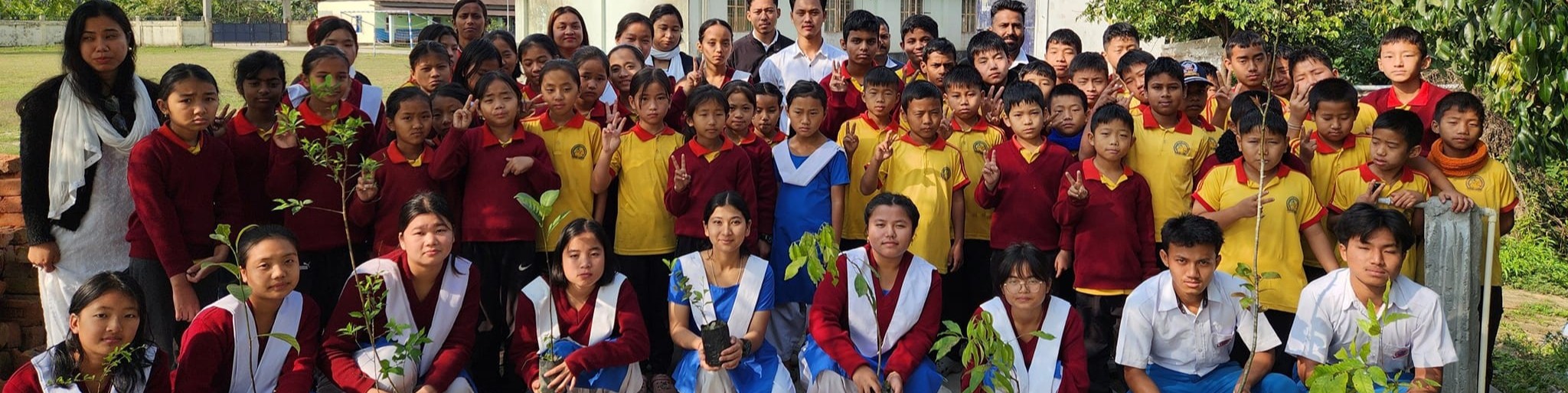
The establishment of Donyi Polo Vidya Niketan at Ngorlung village was a long felt need of the elite elders and villagers of the area and it was realized with the grace of Lt. Krishna Chandra Gandhiji, the founding father of Vidya Bharati schools and Lt. Shantanu Raghunath Shende, the then Organizing Secretary of Vidya Bharati North East and the pioneering efforts of Lt. Nyong Panyang, Shri-Paniram Panyang, Shri-Ojing Aje, Shri-Tabeng Sora, Lt. Tajir Darang, Lt. Dr. Debananda Chutia, Lt. Madhuram Pegu, Lt. S.N. Pathak, Lt. Takab Chandra Medok and many others. The land for the school was jointly donated by Lt. Asem Taying (HGB) and Lt. Talung Taloh (G.B) of Ngorlung village.
The school was formally inaugurated by Shri Gegong Apang, the then Honorable Chief Minister of Arunachal Pradesh on 5th July 1996 as the 5th school of Arunachal Shiksha Vikas Samiti. Down the years, the school has been striving to provide qualitative and nationalistic education based on Bharatiya culture and ideals with special emphasis on the indigenous faith culture and traditions which has been one of the foremost aims and objectives of establishing the school. Though it was a lower primary school at the time of establishment in 1996, it was elevated to the upper primary level in the year 2004 and upgraded to the secondary level in the year 2015. Presently, this institution has been rendering education from Nursery to Class-X (Ten) and planning to upgrade the classes up to higher secondary level soon.The school has sufficient buildings to accommodate classes and hostel. The school is strictly following CBSE syllabus with NCERT text books. The school emphasis on the programs under the 5 core subjects namely Physical Education, Yoga Education, Sanskrit Education, Sangeet Education, and Moral & Spiritual Education.
Being a school established and managed by a nationalistic mass based organization i.e. Vidya Bharati, the school always give utmost priority to the active involvement and participation of the parents and guardians in particular and society as a whole in the school activities and chalk out many a programs for them. We do regularly conduct parents and mothers meeting in the school to appraise the parents about the progress and prospects of their children. The school also constituted 'Matri Bharati', a committee of the mothers for their better involvement and participation in the school's developmental activities.
OUR MISSION
To develop a National System of Education which would help build a younger generation which is committed to Hindutva and infused with patriotic fervour; physically, vitally, mentally and spiritually fully developed; capable of successfully facing challenges of life; dedicated to the service of those of our brothers and sisters who dwell in villages, forests, hills and slums; and are deprived and destitute, so that they are liberated from the shackles of social evils and injustice and thus devoted, may contribute to build up a harmonious, prosperous, and culturally rich Nation.
VIDYA BHARATI - AN INTRODUCTION
Vidya Bharati is providing quality education since 1952 and is committed to educating the young generation according to Bhartiya's values and culture. Some committed and patriotic people, who considered education as an artifice to educate the young generation according to Indian values and culture started the first school in Gorakhpur, UP, in 1952. They named this school as Saraswati Shishu Mandir-Temple of the Goddess Saraswati dedicated to the children. Thanks to their zeal, dedication, and hard work that similar schools began to be established in other places also. The number of such schools increased rapidly in Uttar Pradesh. A state-level Shishu Shiksha Prabandh Samiti was formed in 1958 for their proper guidance and planned development. Good education & sound sanskaras at the Saraswati Shishu Mandirs earned recognition, honor, and popularity in the society. Shishu Mandirs started spreading in other states and within a few years, many schools were established. To manage the affairs in different regions, state-level committees were set up. The formation of a national body came in 1977 and Vidya Bharati Akhil Bharatiya Shiksha Sansthan was established with its Registered office at Lucknow & functional headquarters in Delhi. All state-level committees were affiliated to this Vidya Bharati Akhil Bharatiya Shiksha Sansthan.
At present Vidya Bharati has more than 30,000 eduactional institutions from Pre Primary level to Higher Secondary level including B.Ed Colleges, Teachers' Training Centres, Single Teacher Schools, Sanskar Kendra and the like in which about 45,75,712 students get guidance from 1,28,450 dedicated Achraya / Acharyaa (Teachers).At present Vidya Bharati has more than 30,000 eduactional institutions from Pre Primary level to Higher Secondary level including B.Ed Colleges, Teachers' Training Centres, Single Teacher Schools, Sanskar Kendra and the like in which about 45,75,712 students get guidance from 1,28,450 dedicated Achraya / Acharyaa (Teachers).
ABOUT ARUNACHAL SHIKSHA VIKAS SAMITI
Arunachal Shiksha Vikas Samiti (ASVS) is the state chapter of Vidya Bharati Akhil Bharatiya Shiksha Sansthan in Arunachal Pradesh. The initiatives for founding the Samiti and opening schools under it in Arunachal Pradesh were taken up by Lt Krishna Chandra Gandhi, the father of Saraswati Shishu Mandir Yojana, and It Shri Shantanu Raghunath Shende, who was once one of the first teachers of RK Mission School Aalo. Formally formed on 18th November 1994 with late Jikom Riba (IAS Retd) and Shri Kamen Ringu as the founder President and Secretary, respectively, the ASVS works for the all-round development of Arunachal Pradesh through education based on Bharatiya culture and values with special emphasis on the preservation and promotion of the local indigenous faith, culture, and traditions. ASVS focuses on running schools in different parts of the state in a value-based and learner-oriented environment with an indigenous ambience, aiming at the integrated development of the physical, intellectual, emotional, and cultural aspects of the personality of the child. At present, Arunachal Shiksha Vikas Samiti is running 17 schools of its own, 9 Kasturba Gandhi Balika Vidyalayas (Residential schools for girls under ISSE and one EMRS), and 7 Sanskar Kendras in 15 districts of the state.
HOUSE SYSTEM
With a view to foster camaraderie and competitive spirit among students and to stimulate their desire to excel in scholastic and co-scholastic activities, the school has been organised into four Houses named after four of India’s greatest personalities:
- Siang House
Named after the Siang River, this house symbolizes strength and perseverance. The Siang River is known for its powerful currents, and similarly, students in this house are encouraged to exhibit resilience and determination in all their endeavors.
- Lohit House
Named after the Lohit River, this house embodies the qualities of flow and adaptability. The students of Lohit House are encouraged to be flexible, creative, and open-minded, much like the river that adapts to its surroundings while maintaining its course.
- Tirap House
Named after the Tirap region, this house stands for courage and honor. The students of Tirap House are expected to display bravery in their actions and integrity in their character, upholding the values of respect and responsibility.
- Subansiri House
Named after the Subansiri River, this house represents harmony and balance. Just like the Subansiri River flows gently and steadily, the students of Subansiri House are encouraged to approach their academic and extracurricular pursuits with a calm and balanced attitude.